.png)


Keystone QS: An ERP and HRMS Built for a Quantity Surveying Firm
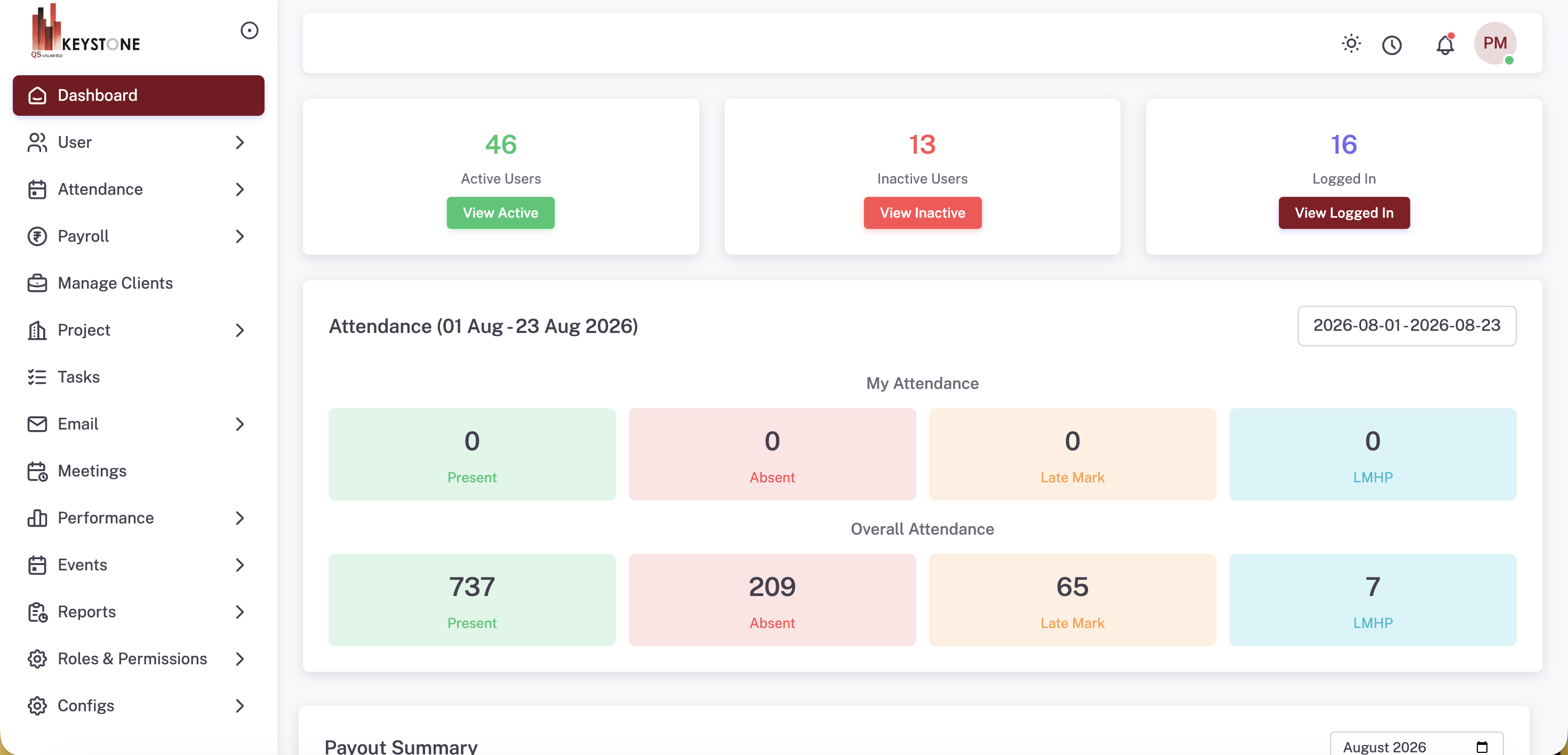
A single web ERP that captures attendance from biometric access-control machines, runs payroll, estimates project durations and keeps projects, tasks and clients in one login.
At a glance
| Client | Keystone QS, quantity surveying & construction consulting |
|---|---|
| Industry | Construction · Quantity Surveying |
| What we built | Web-based ERP + HRMS |
| Stack | Laravel, PHP, MySQL, biometric device integration |
| Services | Custom Software Development, Cloud & DevOps |
The challenge
Keystone QS runs quantity-surveying and cost-consulting work for construction projects, which means a team that is partly in the office and partly on sites, billed against project timelines. Two things were breaking down. Attendance was recorded manually, so in-office hours were unreliable and payroll took reconciliation every month. And there was no dependable way to estimate how long a project would take from the work involved, so planning and client billing were built on guesswork rather than data.
The firm did not want a generic HR tool bolted onto a separate project tracker. It needed attendance, payroll, projects, tasks and client records in one system that understood how a QS firm actually works.
What we built
A single Laravel application with role-based access and six connected modules:
- Biometric attendance. Two access-control machines at the office are integrated directly with the system. Punches mark in-office time automatically: no registers, no manual entry, no end-of-month corrections.
- Project time-estimation engine. Projects are broken into their work components and the engine produces a duration estimate from them, using the firm’s own project history as the reference. That gives the firm a defensible basis for schedules and quotes.
- Payroll. Salary runs are generated from the attendance data, with leave and deductions handled in the same place.
- Project and task management. Each project carries its tasks, owners and status, so managers see where time is going against the estimate.
- CRM. Client and enquiry records sit alongside projects, so the commercial side and the delivery side share one view of each client.
- Role-based access. Directors, project managers and staff each see what they need and nothing else.
How we approached it
We started with the attendance integration because it was the module everything else depended on: payroll and time tracking are only as good as the punch data. Device integration was tested against both machines before any payroll logic was written. The estimation engine came second, built with the firm’s own project history as the reference, and the remaining modules were added in short cycles so the team could start using attendance and payroll while CRM and task management were still in progress.
Results
- Attendance is captured in real time from the biometric devices; manual registers are gone.
- Project duration estimates are generated by the system rather than guessed, giving planning and billing a consistent basis.
- Payroll, projects, tasks and client records are in one login instead of spread across spreadsheets and separate tools.
Related work & services
The same client’s site teams use the Keystone QS Cost Estimation App, built on a Laravel API. We have also worked on an AI-assisted way to query Keystone QS construction data in plain English; see our AI & Automation page. For labour attendance and wages across multiple sites, see Pandit Constructions.
FAQ
Running a consulting or construction firm on spreadsheets and registers?
Talk to us about a custom ERP built around the way your team actually works.
Book a Discovery Call Contact Us