.png)


Take Your AI-Built App to Production, and Keep It There
You built something real with Emergent, Lovable, Bolt or Replit. It works in the builder. Now it needs a server, a database that survives changes, and a safe way to ship updates. That is the part builders do not do, and the part we do: hosting, deploy pipeline, migrations and monitoring, while you keep building in your own tool.
Who This Is For
Founders with a prototype
You shipped on an AI builder, want paying users, and have no production environment.
Apps on the builder’s hosting
You need infrastructure you control, for cost, data residency or features the builder’s hosting lacks.
Inherited AI-generated code
From a freelancer or a co-founder who left, and it needs to be stabilised and running.
What Breaks Between the Builder and Production
It runs in the builder, not on a server
CORS set for the sandbox, URLs hardcoded to localhost, no environment file, the wrong runtime version.
The database is whatever the builder gave you
Emergent defaults to MongoDB; Lovable and Bolt lean on Supabase. Often the wrong shape for your data.
There are no migration files
Builders like Emergent change the database directly, so every production schema change is manual and risky.
The schema has drifted
A customers table appears beside a users table that already has a customer type.
Deploys are manual and scary
Files copied and commands run by hand, hoping nothing breaks.
No one is watching
No restart on crash, no backups. The first alert is a user complaint.
What We Set Up
We do not rewrite your app. We make it safe to run and safe to keep changing in the tool you already use.
Push-to-production pipeline
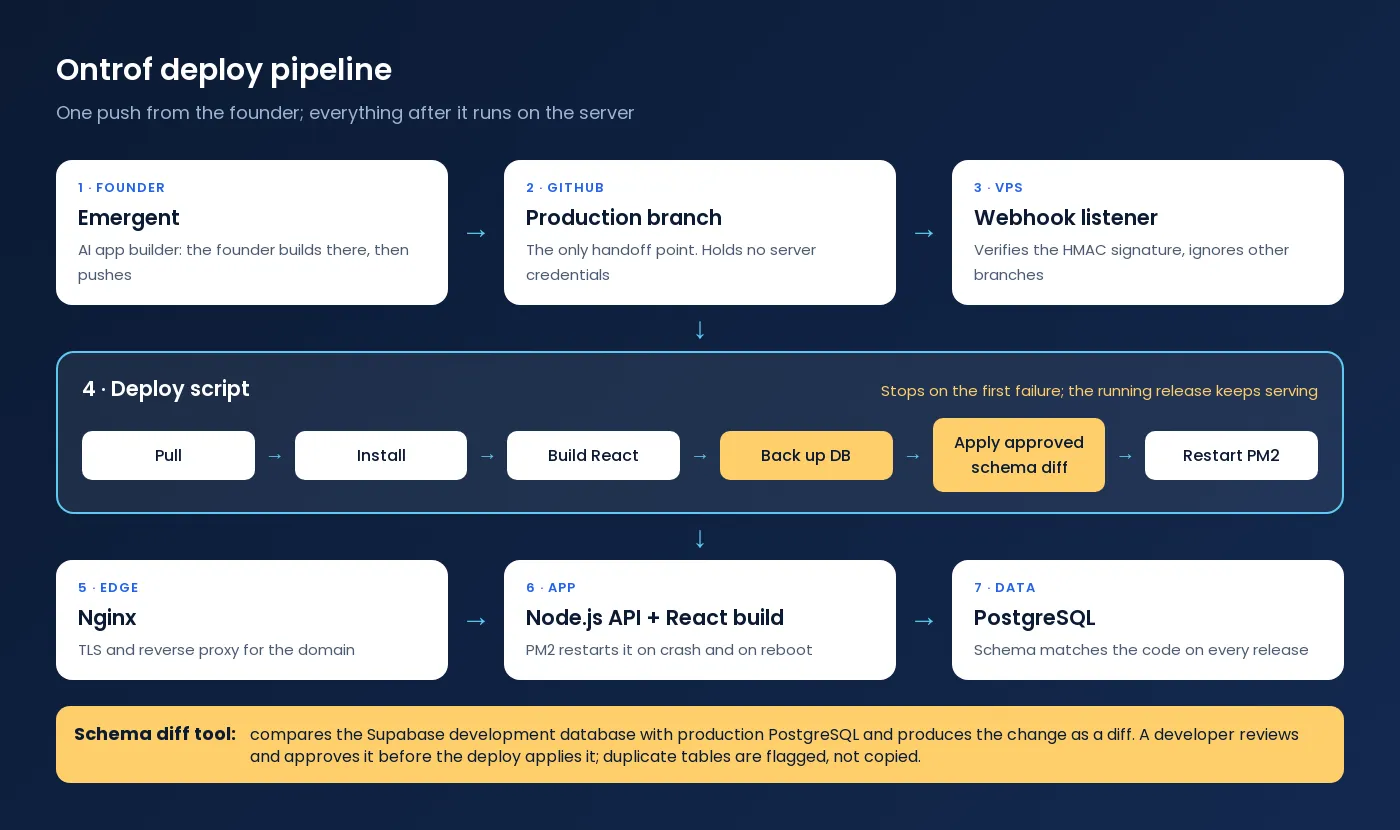
You push from your builder to GitHub; a signed webhook runs the deploy: pull, install, build, back up, apply schema changes, restart. It stops on the first failure, so a bad step never reaches users.
Production server
A VPS or cloud instance you own, Nginx with TLS, PM2 or Gunicorn restarting the app on crash, a firewall, and Cloudflare if you want it.
Environment and build fixes
Everything that stops the builder’s output running on a real server, fixed once and documented.
Database migration, when needed
From MongoDB, Supabase or Firebase to a PostgreSQL you control, as we did for Ontrof. The data layer is adjusted, not rewritten.
Schema-diff tool
Turns development changes into a diff a developer approves, with a backup first. Nothing is applied blind.
Backups and monitoring
Scheduled database backups, uptime monitoring, and alerts to our team.
Founder support
When something breaks, you get the logs and a plain-English fix to make in your builder, within hours.
How an Engagement Runs
Send us the repository (day 1)
We run it by hand on staging and list what stops it working outside the builder.
Fix and stabilise (days 2–4)
Environment and build fixes, plus a database audit of what has drifted.
Server and pipeline (days 4–6)
Server in your account, TLS, backups, and the webhook deploy, tested with a real push.
First production deploy (week 2)
DNS switch, monitoring on; you push a change and watch it go live.
Ongoing operations (monthly)
We watch the pipeline, approve schema diffs and fix failed deploys. You keep building.
// 1. Only GitHub, signed with our shared secret
const sig = 'sha256=' + crypto.createHmac('sha256', SECRET)
  .update(rawBody).digest('hex');
if (!safeEqual(sig, req.headers['x-hub-signature-256']))
  return res.sendStatus(401);

// 2. Only the production branch
if (payload.ref !== 'refs/heads/main') return res.sendStatus(204);

// 3. Deploy; the script stops on the first failure
run('./deploy.sh'); // pull, install, build, backup, migrate, restart
An illustrative, simplified version of the listener.
What It Costs
A one-time setup and a monthly retainer. Prices are for the simple case: one API, one front-end, one database. Anything more is quoted after we see the repository.
Production setup
from ₹1,25,000 / US$1,500 one-time
Server, TLS, backups and monitoring; build fixes; webhook pipeline; schema audit; first production deploy; documentation and handover.
Moves it up: more than one service, a badly drifted schema, or a database migration (quoted separately).
Operations
from ₹40,000 / US$500 per month
Monitoring and backups; every schema diff reviewed; failed deploys fixed within hours; dependency updates. Cancel monthly.
Moves it up: daily deploys, heavy schema change per deploy, or a guaranteed response under an hour.
Setup credit: sign both and the setup fee is credited against your first three months of operations. All prices exclude GST; international clients are invoiced in USD.
Ontrof
A travel quotation product built on Emergent with React, Node.js and MongoDB. We migrated it to PostgreSQL, set up the server and webhook pipeline, and built the schema-diff tool. The founder now ships 3–4 deploys a day, each with one push.
Read the case studyCloud & DevOps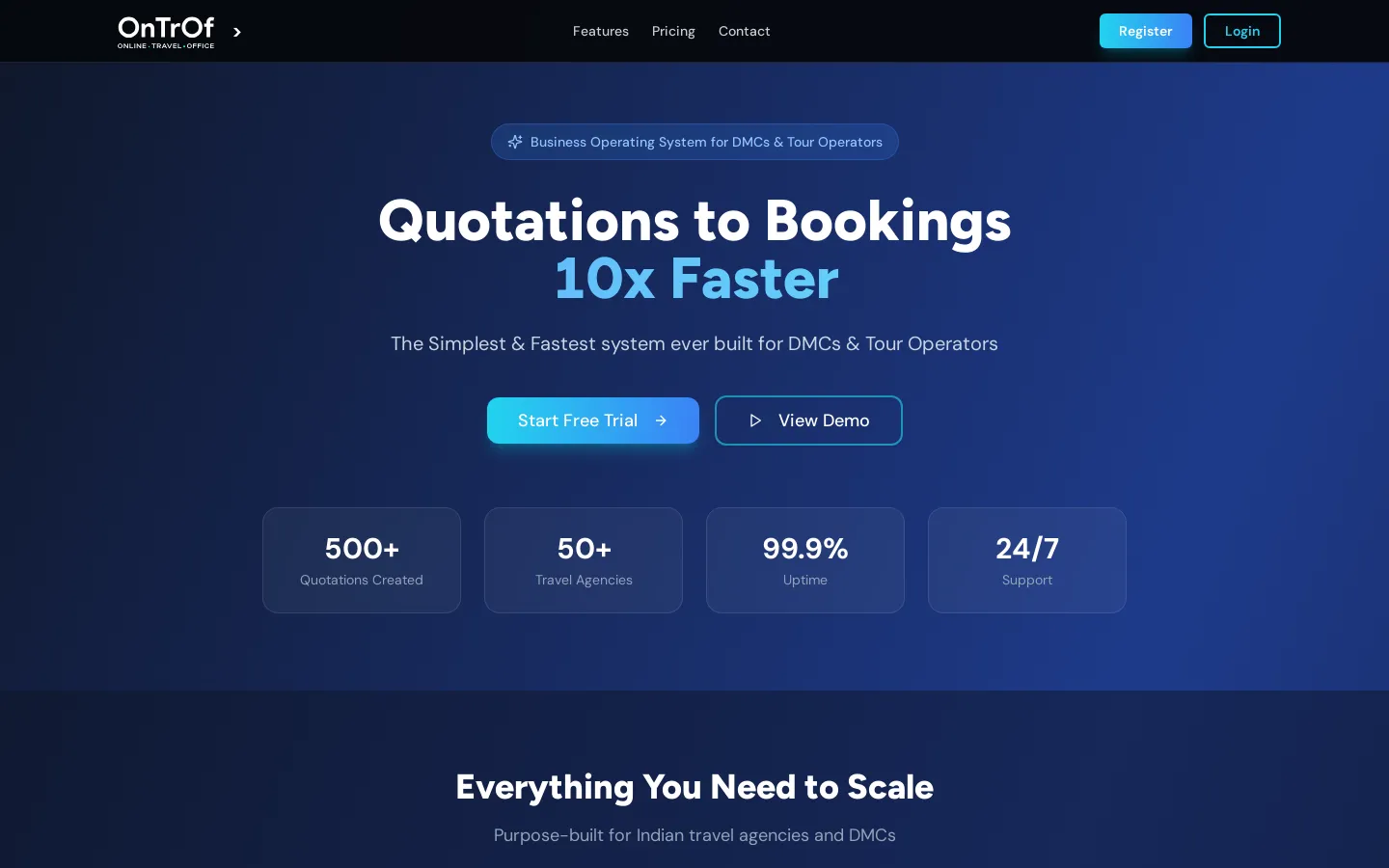
The same operations work runs our own products, RozFlow and Rezolvedesk.
Send Us the Repo
Share the repository or builder export and your domain. Within two working days we will tell you what it needs to go live, how long it will take, and what it costs.